- #hardwood-floors
- #drying
- #bungalows
- #two-flats
- #moisture-content
- #chicago
Wet oak strip floors in a Chicago bungalow can usually be saved if extraction starts within a day or two and the boards are dried slowly from both sides with drying mats and dehumidification, down to a moisture content within 2 to 4 percentage points of the dry boards nearby. Boards that have buckled off the subfloor generally cannot.
The longer answer depends on what is under the boards, how long the water sat, and whose ceiling is below.
What is under a bungalow floor
The Bungalow Belt holds roughly 80,000 brick bungalows built between about 1910 and 1940, concentrated in Portage Park, Beverly, Chatham and Berwyn. Most were floored the same way: 3/4-inch oak strip, usually 2-1/4 inches wide, nailed over a subfloor of 1-inch pine boards laid across the joists. Below that is a full basement, often finished with a drywall or drop ceiling, sometimes with the joists exposed.
Two-flats and three-flats in Logan Square, Pilsen and Albany Park use the same floor system on every level. The difference is that the “basement ceiling” under a second-floor kitchen is the first-floor tenant’s ceiling.
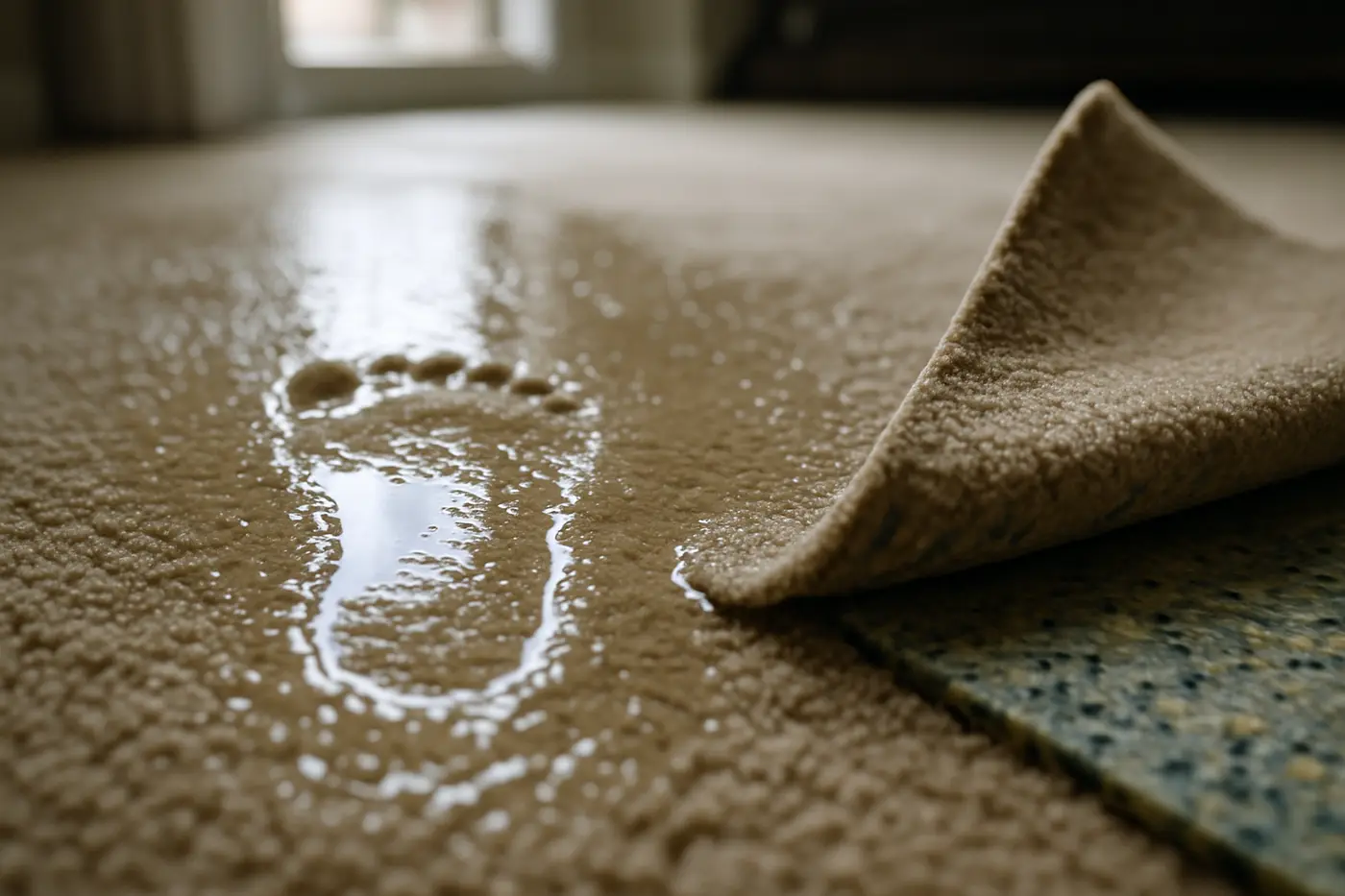
That construction matters because water does not stay on top of an oak floor. It runs into the gaps between strips, soaks the pine subfloor, sits on the tops of the joists and drips through to whatever is below. The oak is the last thing to get wet and the last thing to dry. When we set up drying on a wood floor, we are really drying three layers.
Cupping, crowning and buckling: reading the floor
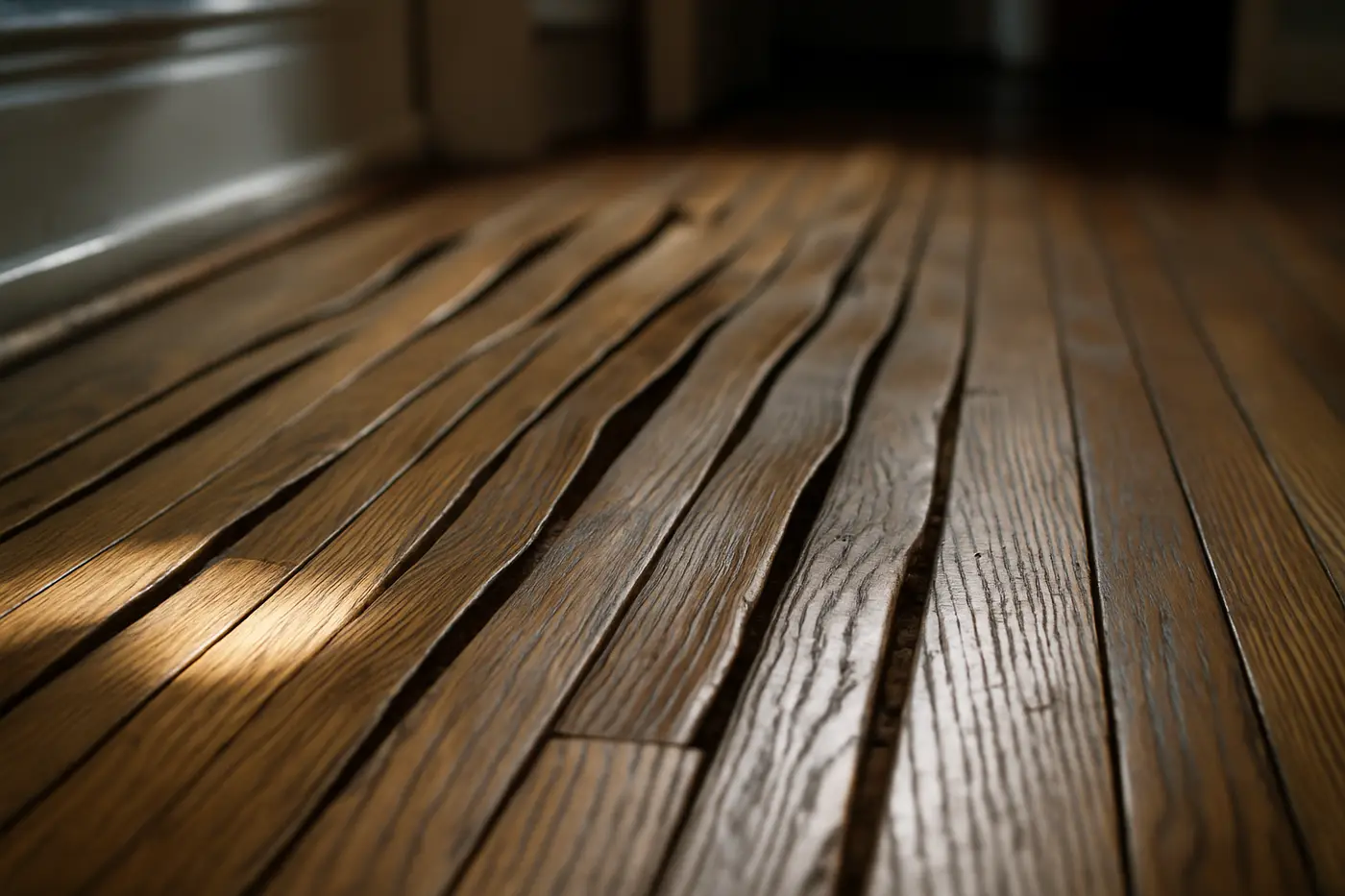
Wet oak moves in three recognizable ways, and each one tells you something different.
| Sign | What you see | What it means | Outlook |
|---|---|---|---|
| Cupping | Board edges sit higher than the centers; the surface feels like a washboard | The underside of the board is wetter than the top. Water came from below or soaked through the gaps | Usually recoverable if drying starts within days. Boards often flatten as the moisture equalizes |
| Crowning | Board centers sit higher than the edges | The top of the board is wetter than the bottom, or a cupped floor was sanded flat before it finished drying | Recoverable if it is a moisture imbalance; if it was sanded too early, the crown is permanent |
| Buckling | Boards lift off the subfloor, tent upward, pull nails and separate at the seams | Severe saturation, usually water that sat for days or a floor with no room to expand | Replacement of the affected boards, and often the subfloor beneath them |
The most expensive mistake on a wood floor is sanding a cupped floor while it is still wet. The sander levels the high edges, the boards keep drying and shrinking, and the floor that was flat in week two is crowned in month two. We do not let a floor refinisher near a water-damaged floor until the readings have been stable for a week.
The first 48 hours
Most of what decides whether the floor survives happens before the drying equipment arrives.
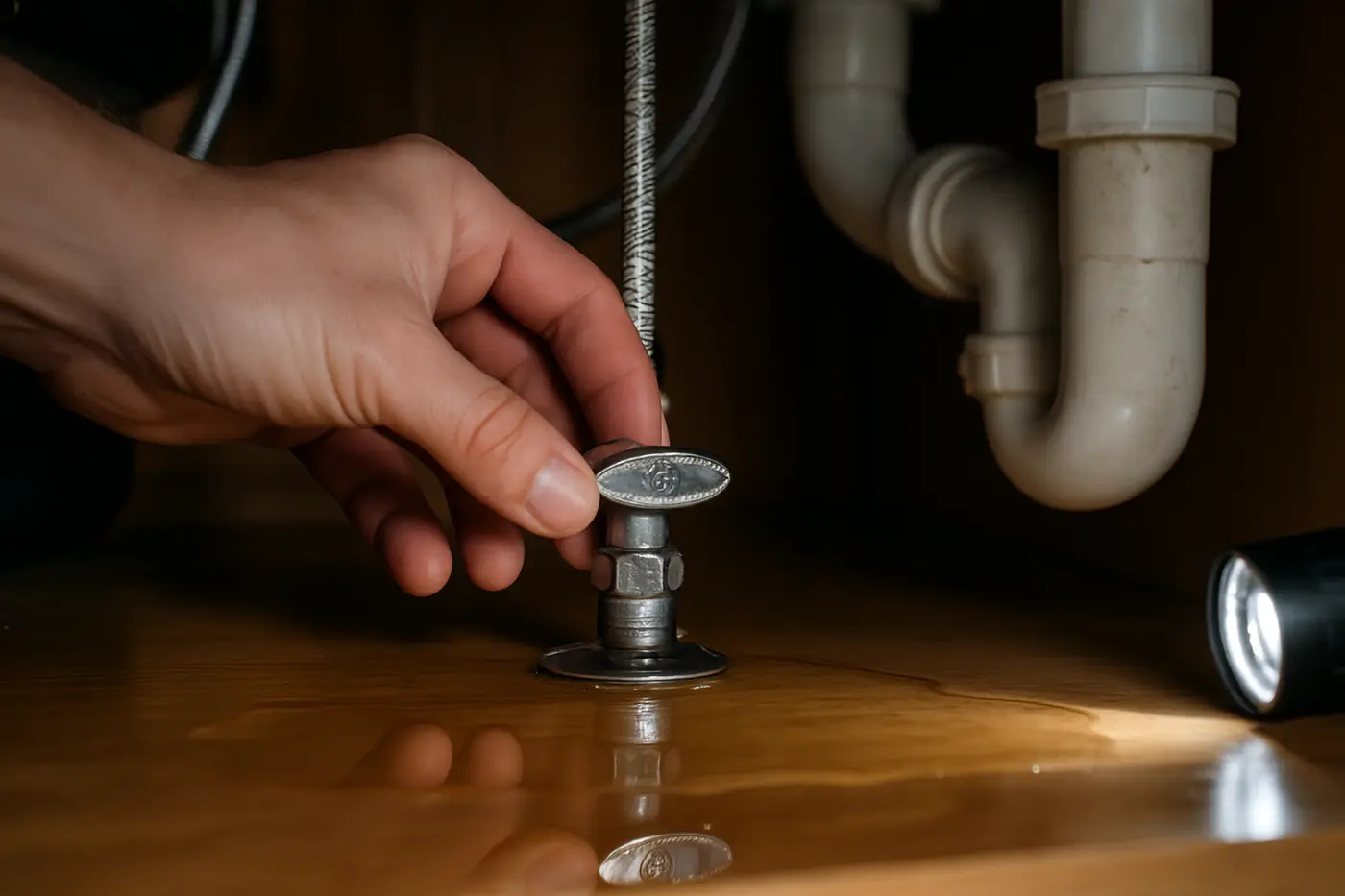
- Stop the source: the dishwasher supply, the refrigerator line, the radiator valve, the upstairs tub.
- Get standing water off the surface with a squeegee and a wet vacuum, not towels.
- Pull up rugs and move furniture off the wet area. Put foil under the legs of anything too heavy to move.
- Do not crank the furnace or set up space heaters. Fast heat drives the top of the board dry while the bottom stays wet, which is how cupping turns into checking and splits.
- Do not open the windows in July. Chicago summer dew points of 65 to 75 degrees Fahrenheit mean outside air adds moisture rather than removing it.
- Go to the basement. Look at the ceiling under the wet room for staining, sagging drywall or drips. Photograph it.
- Call for water extraction the same day, and follow the sequence in our first hour after water damage guide.
How drying mats pull water out of a wood floor
Air movers alone dry the top face of the boards. The problem is underneath, in the subfloor and in the cavity between the joists. A drying mat system solves that.
The mats are flat panels laid over the wettest boards and sealed to the floor, connected by hoses to a high-pressure blower. Instead of blowing air across the wood, the system pulls air down through the seams between the strips, through the subfloor and into the joist bay, then out. Moisture that would take weeks to migrate up through 3/4 inch of oak is drawn out along the same paths the water used to get in.
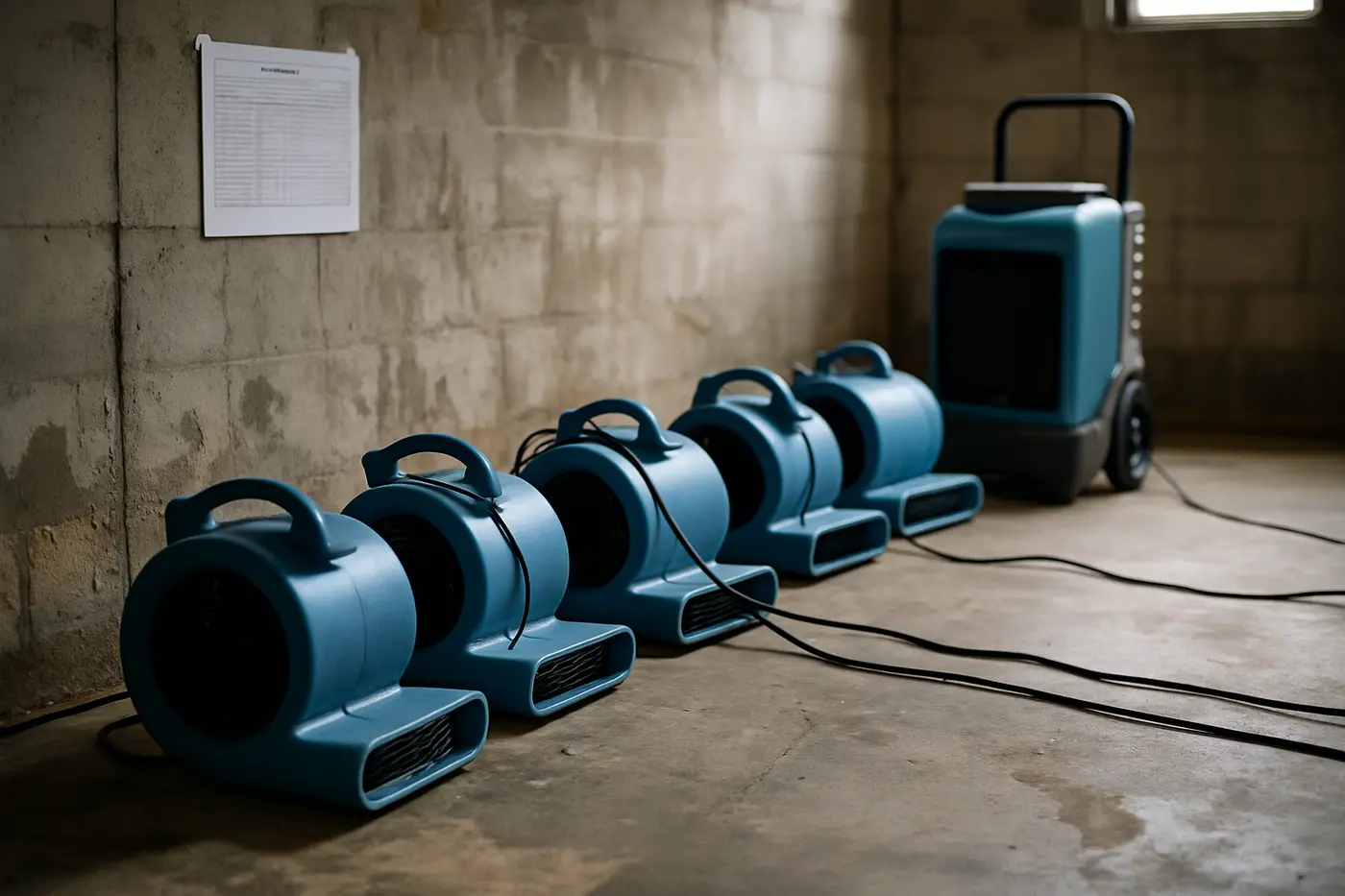
Around the mats, the setup looks like this:
- A low-grain refrigerant dehumidifier sized for the room, holding the air at a controlled humidity so the top of the boards releases moisture without being shocked.
- Air movers angled low across the floor outside the mat area.
- In the basement below, air movers and often a second dehumidifier aimed at the underside of the subfloor. If the basement ceiling is drywall and it is wet, sections come down so the cavity is open. If it is a drop ceiling, the tiles come out.
- Daily pin meter readings on the oak, the subfloor and the joists, logged against reference readings from a dry part of the house.
Structural drying equipment is billed at $50 to $125 per unit per day, and hardwood floor drying in Chicago typically runs $400 to $1,800 per area. That is a fraction of what a new floor costs.
Moisture content targets: the numbers we wait for
Oak in a heated Chicago house sits at an equilibrium moisture content in the mid to high single digits, lower in winter when the furnace runs and higher in a humid August. The target is not a fixed number. It is the reading from the dry, unaffected boards in the next room, measured with the same pin meter set for the same species.
We call a floor dry when:
- The wet boards read within 2 to 4 percentage points of the dry reference boards.
- The subfloor reads within a similar range of a dry section of subfloor.
- The readings have held steady for at least two consecutive days with the equipment still running.
- The joists and the basement ceiling cavity below are dry, not just the visible surface.
A typical clean-water loss on a bungalow floor takes 5 to 10 days of drying, longer if the water sat for several days before anyone called or if the basement below is cool and damp. The EPA notes that wet materials left more than 24 to 48 hours can support mold growth. Pulling equipment on day three because the surface feels dry is how a floor cups again a month later.
Sand and refinish, or replace?
Once the readings are stable, the floor is left alone for several weeks to acclimate. Then the decision is made board by board.
Sand and refinish when:
- Cupping has largely flattened and what remains can be sanded out without going through the wear layer.
- The finish has whitened, peeled or water-stained but the wood underneath is sound.
- Discoloration is light and mostly in the finish.
- The water was clean (Category 1) or gray (Category 2) and the boards dried within the first week.
Replace boards when:
- Boards buckled, tented or pulled their nails.
- Gaps are wide enough that the tongue no longer engages the groove.
- Black staining runs deep into the grain, which sanding will not remove.
- The floor is engineered rather than solid and the plies have delaminated.
- The water was Category 3 sewage. Wood that soaked in black water is removed under the S500 standard, not sanded.
Replacement on a bungalow floor is usually partial. Old 2-1/4-inch oak strip is still made, damaged boards are cut out and new ones are laced in, and the whole room is then sanded and finished so the color matches. Whole-floor replacement is reserved for buckling across most of a room or a subfloor that has rotted.
The subfloor and the ceiling below
The pine subfloor is the layer people forget. It is thicker than the oak, it holds water like a sponge, and it is hidden. A subfloor that reads wet while the oak reads dry will feed moisture back into the boards for months.
In a bungalow, we treat the basement ceiling as part of the drying job. Wet drywall under the leak is cut back, wet insulation is removed, and the joist bay is dried with the mats pulling from above and air movers pushing from below. If the water came from a supply line and was caught quickly, the ceiling can often be dried without removal.
In a two-flat or three-flat, the same physics applies but the ceiling belongs to another unit. Water from a burst supply line on the second floor travels down through the first-floor ceiling and can reach the garden unit. Both units need to be metered and documented, and if the building is a condominium, the association and its master policy come into the conversation. We cover the paperwork in our water damage insurance claim guide for Illinois.
Winter and summer: when bungalow floors get wet
The two peak seasons for wood floor calls are opposite ends of the year. In winter, a radiator valve or a supply line in an exterior wall freezes and lets go, usually in the thaw week after a deep cold snap like the polar vortex of January 2019 or the Christmas cold snap of December 2022. Watch the National Weather Service for cold and wind chill warnings before a deep freeze. In summer, the dishwasher, the refrigerator ice-maker line or an upstairs tub overflow does it, and the humid air makes every stage of drying slower. Either way, the sooner the floor is metered and the mats go down, the smaller the sanding job at the end.
Key takeaways
- Oak strip over a plank subfloor gets wet from the bottom up and dries from the bottom up. Drying the surface alone is not enough.
- Cupping is usually recoverable; crowning after early sanding is permanent; buckling means replacement.
- Drying mats pull air through the seams and subfloor. Combined with an LGR dehumidifier and air movers in the basement, they dry all three layers.
- The target is a reading within 2 to 4 points of the dry reference boards, held for two consecutive days, with the subfloor and joists dry too.
- Expect 5 to 10 days of drying, then several weeks of acclimation before anyone sands.
- Sewage-soaked wood is removed, not sanded.
- In two-flats and three-flats, the ceiling below belongs to someone else. Document both units.
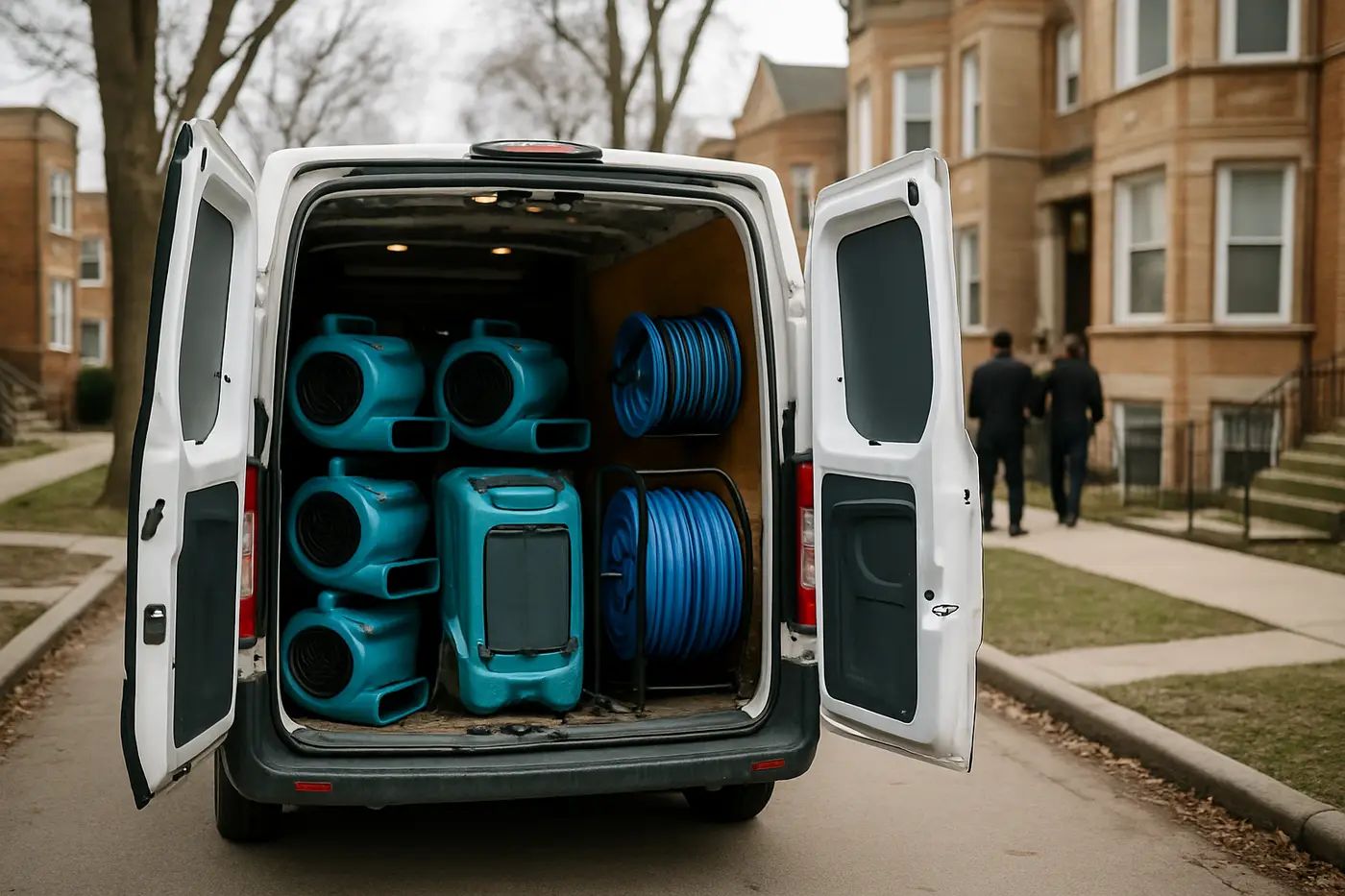
If a floor in your bungalow or two-flat is wet now, get the standing water up, check the basement ceiling, and call us or send the form. Our water damage restoration crews cover the Bungalow Belt from Beverly and Chatham to Cicero, and the two-flat blocks of Logan Square and Pilsen.