- #insurance-claim
- #documentation
- #adjuster
- #xactimate
- #illinois
- #moisture-log
To document a water damage claim in Illinois, photograph and video the loss before anything is moved, keep the failed part, record the date and time, log moisture readings and drying equipment daily, get an itemized scope of work, and keep every receipt. Report the claim promptly and write down every conversation with the adjuster.
Adjusters decide claims on evidence. This is the sequence we use on every insured job in Chicago and the suburbs.
Before you start: what an Illinois homeowners policy covers
A standard HO-3 policy covers sudden and accidental discharge of water: a burst pipe, a failed water heater, a split appliance supply line, and frozen pipes if you kept reasonable heat on. It excludes surface flooding from rivers and overland flow unless you carry a separate flood policy through the NFIP or a private carrier. It excludes sewer backup and sump pump overflow unless you added a water backup endorsement. And it excludes gradual leaks and long-term seepage.
Your documentation has to show two things: that the loss was sudden, and that you acted quickly to limit the damage. Mitigation and emergency services are covered when they are documented. If the water came through a floor drain during a storm, read sewer backup vs flood first, because the coverage question changes the whole claim.
Step 1: Photograph before anything moves
The best evidence is the room as it looked when you found it.
- Wide shots from each doorway showing the whole room and the extent of the water.
- Medium shots of each wall, the floor and the ceiling, including the water line on the drywall.
- Close-ups of the source: the pipe, the fitting, the tank, the appliance.
- Every damaged item, in place, with a wide shot showing where it sat and a close-up showing the damage.
- The rooms below, including the basement ceiling in a bungalow or the unit below in a two-flat.
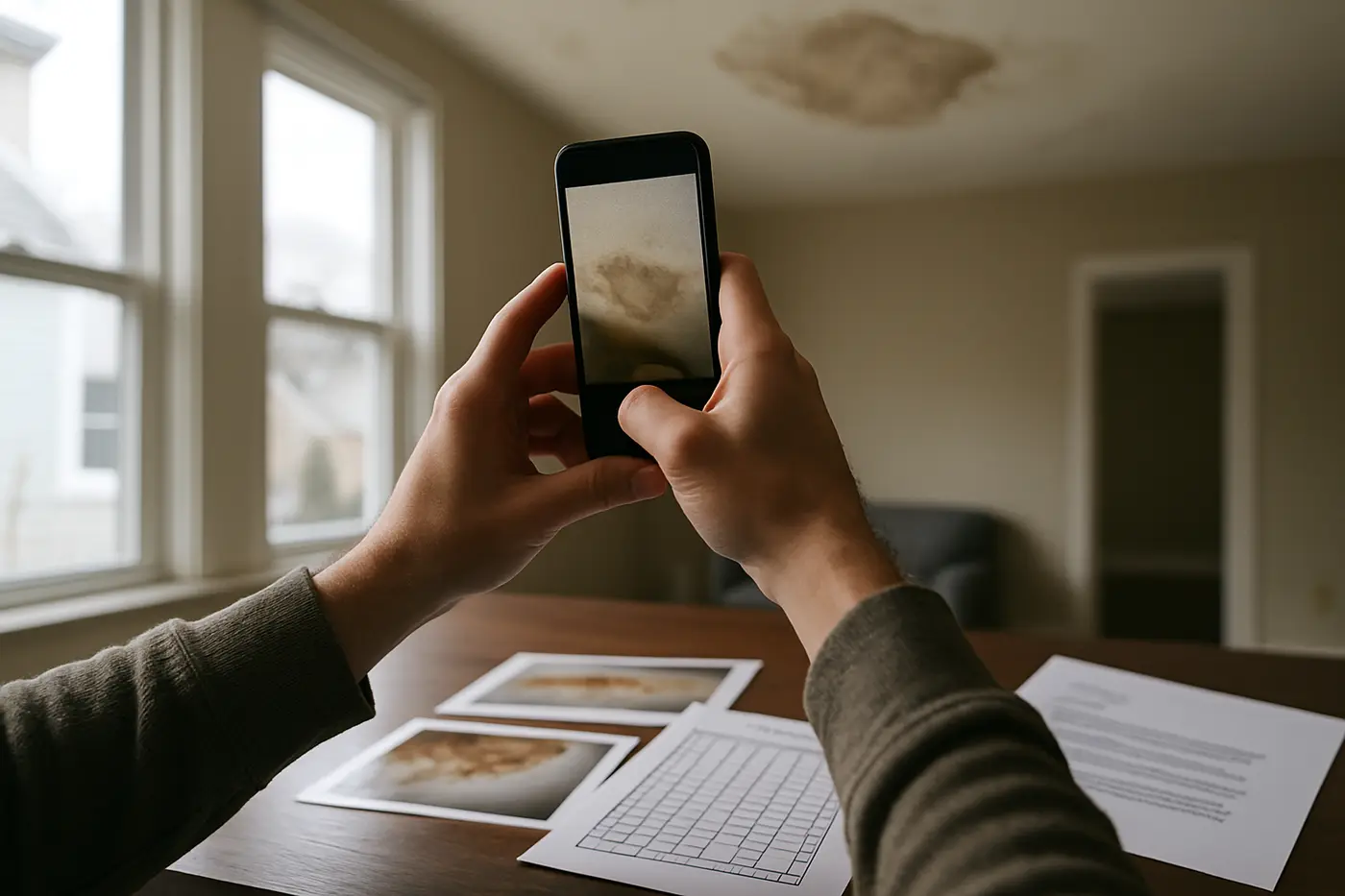
Your phone stamps date and time on every image. Do not edit or crop the originals; back them up to a cloud folder the same day.
Step 2: Shoot a slow video walkthrough
Photographs show what; video shows how much and how far. Walk every affected room at a slow pace, narrating what you see and the time. Point the camera at the floor, then the base of each wall, then the ceiling. In a multi-unit building, do the same in the unit below with the occupant’s permission.
Step 3: Keep the source part
When the plumber replaces the split supply line, the cracked fitting or the failed water heater valve, ask for the old part and photograph it next to a tape measure. Put it in a bag with the date on it. Adjusters use the failed component to confirm the loss was sudden rather than a slow drip. Do not let the part leave on the plumber’s truck.
Step 4: Write a timeline
On the same day, write down:
- When you last saw the area dry.
- When and how you discovered the water.
- What you did and when: shut off the main, called the plumber, moved contents, called the restoration company.
- Weather, if relevant: a burst pipe on the second morning of a cold snap, or a backup during the July 2023 storm.
Keep adding to it: every call with the insurer, the name of the person you spoke to, what they said, and any claim number or reference they gave you.
Step 5: Report the claim promptly
Call the carrier or use its app as soon as the immediate emergency is under control. Policies require prompt notice; waiting a week to “see how bad it is” invites questions. Get a claim number and the adjuster’s contact details. Ask three things: whether emergency mitigation is authorized, whether the carrier accepts direct billing from the restoration contractor, and whether your policy carries a water backup endorsement and what its limit is.
You do not need permission to start mitigation. Insurers expect you to prevent further damage.
Step 6: Mitigate, and log what you do
Emergency work is claimable when it is documented. That means:
- Receipts for anything you buy: a wet vacuum, fans, a dehumidifier, plastic sheeting, contractor bags.
- The restoration company’s emergency service invoice, showing the date, hours on site, equipment placed and the water category.
- Photos of the work as it happens: extraction, the carpet pad coming out, the drywall flood cut.
- A contents inventory: every item discarded, with a photo, a description and a rough replacement value. Do not throw anything away without a photo.
Our emergency water damage call-out includes moisture mapping and a written report, and the $250 to $500 fee is credited against restoration work. That report is the first document the adjuster will ask for.
Step 7: Moisture logs and the drying log
This is where do-it-yourself claims fall apart. An adjuster cannot see that a wall was wet three weeks ago. A moisture log can.
On day one the technician maps every affected material with a pin meter or a non-invasive meter and records the readings against a dry reference from an unaffected area. That map decides what gets dried and what gets removed. From then on, the readings are taken daily until the materials reach their dry standard.
The drying log tracks the equipment and the air alongside the readings. A typical entry looks like this:
| Date | Room | Material | Reading | Dry standard | Temp / RH | Equipment |
|---|---|---|---|---|---|---|
| Day 1 | Basement family room | Bottom plate, north wall | 32% MC | 12% MC | 64 F / 71% RH | 4 air movers, 1 LGR dehumidifier |
| Day 3 | Basement family room | Bottom plate, north wall | 21% MC | 12% MC | 68 F / 48% RH | 4 air movers, 1 LGR dehumidifier |
| Day 5 | Basement family room | Bottom plate, north wall | 13% MC | 12% MC | 70 F / 42% RH | Equipment pulled day 6 |
Why the carrier cares: equipment is billed per unit per day, at $50 to $125 in Chicago. The log proves the equipment was needed on every day it was billed and shows the exact day the materials reached dry standard.
Ask for a copy of the log at the end of the job and keep it with your claim file. Our guide to how long a basement takes to dry explains what the readings mean.
Step 8: The itemized scope and Xactimate
The scope of work is the document that turns damage into dollars. It lists every task, room by room, with a quantity and a unit: square feet of carpet removed, linear feet of flood cut, days of equipment, square feet of antimicrobial application, number of contents moved.
Most Illinois carriers and most restoration contractors write that scope in Xactimate, the estimating platform that uses a regional price list. When your contractor’s estimate and the adjuster’s estimate are both in Xactimate, the conversation is about line items and quantities rather than lump sums, and disagreements narrow to specifics. A one-line quote for “water damage, $6,000” will be sent back.
Ask for the scope before the adjuster visit and check it against your photos.
Step 9: The adjuster visit
The adjuster may inspect in person or ask for photos and a video call. Either way:
- Have the timeline, photos, video, source part, contents list, receipts, moisture map, drying log and scope ready in one folder.
- Do not rebuild before the visit. Leave the flood cut open and the removed materials bagged where they can be seen, unless the adjuster has told you in writing to proceed.
- Have your restoration technician on the call or on site if you can. Questions about categories, dry standards and equipment days are answered faster by the person who took the readings.
- Take notes on what the adjuster says and confirm anything important by email afterward.
If the adjuster’s scope leaves out work that your photos show was necessary, respond in writing with the photo and the line item. Most disagreements resolve at this stage.
Step 10: Direct billing and payment
Where the carrier approves it, we bill the insurer directly for the mitigation and drying, and you deal with the deductible and any items the policy does not cover. Ask the adjuster to confirm direct billing in writing and to copy you on the approved scope. Payment for the rebuild often comes in stages, with a holdback released when the work is finished, so keep the completion photos and the final invoice.
Your policy may also require a signed proof of loss statement within a set period after the carrier requests it. Check the conditions section of the policy and do not miss that date.
If the claim goes wrong: the Illinois Department of Insurance
If the carrier denies a claim you believe is covered, delays without explanation, or offers an amount that does not match the documented scope, ask for the denial or the offer in writing with the policy language it relies on. Respond with your evidence. If that does not resolve it, the Illinois Department of Insurance accepts consumer complaints against carriers licensed in the state and will ask the company to respond. A public adjuster or an attorney is a further step for larger disputes.
Federal disasters: FEMA only after a declaration
FEMA Individual Assistance and SBA disaster loans are not a substitute for insurance and are not available for an ordinary burst pipe. They open only after a federal disaster declaration, as happened for Cook County after the July 2, 2023 storms and after the April 2013 flooding. Even then, assistance is generally for losses not covered by insurance, and the same photos, receipts and timeline are what the application asks for.
Key takeaways
- Photograph and video everything before anything is moved, and keep the originals.
- Keep the failed part; it proves the loss was sudden.
- Write a dated timeline and add every insurer conversation to it.
- Report promptly, get a claim number, and ask about direct billing and any water backup endorsement.
- Mitigation is covered when documented: receipts, the emergency service report, photos of the work.
- The moisture map, daily readings and drying log justify every equipment day billed.
- An itemized scope, usually in Xactimate, is what the adjuster works from. Check it against your photos.
- Illinois Department of Insurance for disputes; FEMA only after a federal declaration.
If you have water in the house now, start with the photos, then call us or send the form. Our water damage restoration crews document every job to this standard and bill the carrier directly where the carrier approves. For a winter loss, our frozen and burst pipe page covers the cold-weather specifics that adjusters ask about.